The True Story of Amos 'n' Andy radio series
The story of Amos 'n' Andy is one of the most influential and controversial phenomena in American entertainment history. It spanned radio, film, and television from the late 1920s to the 1960s.
It began in the mid-1920s when two white performers, Freeman Gosden and Charles Correll, who had experience in vaudeville and minstrel traditions, created a radio series. They first launched a similar program called Sam 'n' Henry in 1926 on Chicago's WGN station. It featured two Black characters who migrated from the South to the big city.
When they moved to another station (WMAQ) in 1928 and could not keep the original names due to rights issues, they rebranded the characters as Amos Jones (voiced by Gosden) and Andrew "Andy" Brown (voiced by Correll). The new series, Amos 'n' Andy, premiered on March 19, 1928, initially as a local Chicago show.
The premise followed two working-class Black men from Georgia who moved north, first to Chicago and later to Harlem in New York City, chasing opportunities during the Great Migration era. Amos was portrayed as earnest, hardworking, and somewhat naive, often driving a taxi. Andy was more laid-back, scheming, and gullible. A major character added later was George "Kingfish" Stevens (also voiced by Gosden), the fast-talking lodge leader of the fictional Mystic Knights of the Sea, whose get-rich-quick schemes often involved duping Andy and others.
The show exploded in popularity. By 1929, it went national on NBC and became a nightly serial that drew massive audiences, sometimes estimated at 40 million listeners (a huge portion of the U.S. population at the time). It was a cultural phenomenon during the Depression. People scheduled their evenings around it, and some theaters even delayed movie start times so audiences could listen. Gosden and Correll wrote and performed nearly all voices themselves, using exaggerated dialect rooted in minstrel show traditions.
The format shifted in 1943 from a daily serial to a weekly sitcom. It continued until 1955 on radio, with a final music-focused version (Amos 'n' Andy Music Hall) running until November 25, 1960.
In 1951, CBS adapted it for television as The Amos 'n' Andy Show, a landmark as the first U.S. TV series with an all-Black cast. Black actors took over the main roles: Alvin Childress as Amos, Spencer Williams Jr. as Andy, and Tim Moore as the Kingfish, along with a talented ensemble including Ernestine Wade (Sapphire), Amanda Randolph, and others. Plots often revolved around Kingfish's outlandish schemes, lodge antics, and everyday comedic situations in Harlem.
However, controversy surrounded the series almost from the start. Critics, including parts of the Black community and later the NAACP, argued it perpetuated harmful racial stereotypes. It portrayed Black people as lazy, scheming, dishonest, or buffoonish, with exaggerated dialect and caricatured behaviors drawn from minstrel traditions.
Protests dated back to the 1930 radio era but intensified with the TV version. The NAACP called it a "gross libel" that reinforced negative views of African Americans. After campaigns and boycotts, CBS canceled the TV series in 1953 after just two seasons (though it ran in syndication until the mid-1960s).
Today, Amos 'n' Andy is remembered as groundbreaking for its massive popularity, its role in early radio comedy, and for providing work to Black performers on TV when opportunities were scarce. At the same time, it is widely criticized for relying on racial stereotypes that reflected and reinforced the prejudices of its era. The show remains a complex chapter in media history, illustrating both the power of entertainment and the evolution of attitudes toward race and representation.
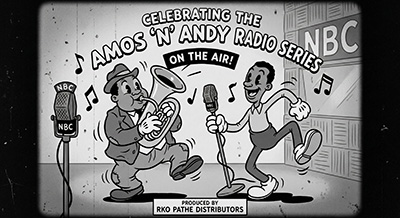
Amos 'n' Andy